
Oct 24, 2026Services & Solutions
Premix & Custom Blending in China: A Practical Guide for B2B Buyers
A practical guide to custom premix and blending in China, covering formulation requirements, MOQ, quality considerations, and how ANADYO coordinates third-party manufacturing projects.
Premix & Custom Blending in China: A Practical Guide for B2B Buyers
Developing a multi-ingredient product often involves more than sourcing individual raw materials. Buyers may need to manage several ingredient suppliers, different minimum order quantities, technical specifications, and a manufacturing process that can consistently produce the required blend.
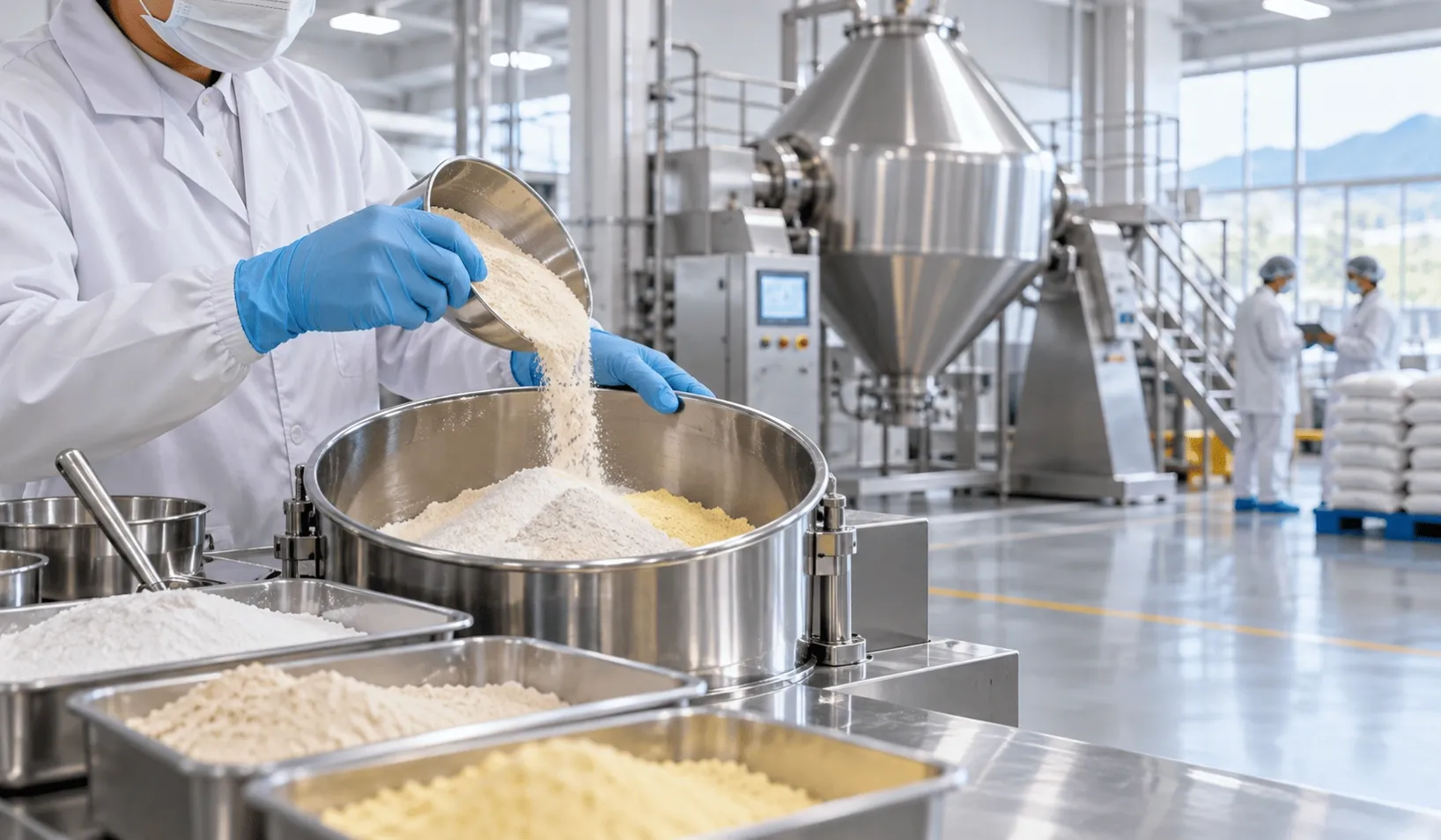
Custom premixing brings selected ingredients together into an agreed intermediate blend for further processing, formulation, or packaging.
At ANADYO, we help international buyers organize premix and custom blending projects in China by coordinating ingredient sourcing, suitable third-party manufacturing partners, technical communication, and agreed delivery requirements.
What Is Premix & Custom Blending?
A premix is a combination of two or more ingredients blended according to defined proportions or specifications, typically for use in a subsequent manufacturing process.
For example, a nutritional premix may combine selected vitamins, minerals, amino acids, or other functional ingredients into a single blend intended for further processing into capsules, tablets, or nutritional powders.
Custom blending allows the composition and processing requirements to be defined around a particular product or application.
It is important to distinguish three types of supply:
- Individual Ingredient Supply: Purchasing separate raw materials without combining them.
- Custom Premix Supply: Combining specified ingredients into an agreed intermediate blend.
- Finished-Product Manufacturing: Using a formulation to produce the final dosage form or packaged consumer product.
These activities can be arranged independently or as connected stages of a larger project.
A customer who already has a finished-product manufacturer may need only a premix. Another customer may require additional processing, filling, or packaging.
The appropriate scope depends on the project, rather than a fixed manufacturing package.
When Does a Custom Premix Make Sense?
Custom premixing may be useful when a formulation contains several ingredients that must be weighed, handled, and incorporated into a downstream production process.
Consider a manufacturer developing a multi-ingredient nutritional powder.
One ingredient may be required in relatively large quantities, while another is used at a much lower inclusion level. Purchasing each material separately creates additional sourcing, weighing, documentation, and handling requirements.
A custom premix may simplify part of that workflow by combining selected ingredients before final manufacturing.
Potential applications include:
- Vitamin and mineral premixes for nutritional products
- Amino acid and functional ingredient blends
- Powder blends for food and beverage applications
- Intermediate blends for capsules and tablets
- Customized ingredient combinations for animal nutrition or pet care
However, a premix is not automatically the best solution for every formulation.
Some ingredients may be sensitive to moisture, incompatible with other components, difficult to blend uniformly, or unsuitable for particular processing conditions.
Technical feasibility should be assessed before a formulation is approved for blending.
What Should Buyers Evaluate Before Starting a Blending Project?
Price is only one part of selecting a premix manufacturing solution.
A lower blending quotation may not represent better value if the manufacturing process, material specifications, quality controls, or delivery arrangements do not meet the intended application.
Several considerations deserve attention.
1. Formulation and Ingredient Specifications
The project should establish which ingredients are required, their grades, intended proportions, and any relevant technical requirements.
Important considerations may include:
- Ingredient identity, purity, and concentration
- Particle size and physical characteristics
- Moisture sensitivity and storage requirements
- Ingredient compatibility
- Intended use and destination-market requirements
Where an existing formulation is available, it provides an initial basis for technical evaluation.
For projects starting from a product concept, further formulation discussions or development support may be necessary through an appropriately capable manufacturing or technical partner.
2. Blend Uniformity and Processing Suitability
Combining powders does not automatically produce a suitable or uniform blend.
Ingredients with different particle sizes, densities, flow properties, or inclusion levels may require particular handling and mixing approaches.
Depending on the formulation, technical assessment may involve blending sequence, mixing equipment, sampling methods, uniformity testing, or other process controls.
The required controls and acceptance criteria should be determined with the responsible manufacturing partner.
Where relevant, additional evaluation may also be needed for stability, downstream processing performance, or storage conditions.
3. Batch Size and Minimum Order Quantity
The minimum order quantity for a custom premix depends on more than the amount of material a buyer wants to purchase.
Factors may include:
- Available equipment and suitable working batch sizes
- Ingredient purchasing quantities
- Formulation complexity
- Trial or sampling requirements
- Testing and documentation
- Packaging and production arrangements
For this reason, a universal MOQ is rarely a useful starting point for a custom blending inquiry.
Buyers should provide an estimated order quantity or target batch size and ask suppliers to assess technical and commercial feasibility.
4. Quality Documentation and Traceability
Before production, buyers should clarify which documents and quality records are required.
Depending on the project and manufacturing partner, these may include ingredient specifications, Certificates of Analysis (COAs), relevant manufacturing or quality certifications, test reports, and batch traceability records.
Not every document is available for every formulation, partner, or destination market.
It is therefore important to confirm documentation requirements and availability during the initial evaluation rather than assume they can all be provided after production.
How ANADYO Coordinates Premix & Custom Blending Projects
ANADYO is a China-based ingredient sourcing and supply chain solutions company.
For entrusted manufacturing projects, clients engage ANADYO as their commercial and project contact. We organize agreed project activities through suitable third-party manufacturers in China.
Our approach follows the requirements of each project.
Step 1 — Understand the Requirements
We begin by reviewing the product concept or existing formulation, ingredient specifications, intended application, estimated volume, target market, and preferred delivery format.
The goal is to understand what the customer actually needs before proposing a manufacturing arrangement.
Step 2 — Explore Suitable Manufacturing Options
Based on the requirements, we identify and evaluate potential manufacturing partners.
Relevant considerations include technical capabilities, available equipment, suitable batch sizes, quality systems, documentation, and commercial conditions.
Manufacturing suitability must be confirmed for the specific project.
Step 3 — Align Technical and Commercial Details
We coordinate discussions covering formulation requirements, sampling, technical feasibility, quotations, MOQ, lead times, and applicable responsibilities.
Where technical evaluation, trials, or additional development are necessary, these activities are discussed with the appropriate third-party partners.
Step 4 — Coordinate the Agreed Production Scope
Following project confirmation, ANADYO coordinates the relevant suppliers and manufacturing partners according to the agreed scope.
This may include production scheduling, documentation follow-up, packaging arrangements, and delivery coordination.
The appointed manufacturing partner performs the production and related testing activities assigned to it.
ANADYO remains responsible for its own contractual commitments, with quality, product acceptance, documentation, and delivery responsibilities clarified in the applicable project agreement.
Can Buyers Request Only a Premix Without Finished-Product Manufacturing?
Yes. A custom premix can be supplied as a standalone intermediate product when technically and commercially feasible.
For example, a buyer may already have an established production facility outside China but require a selected ingredient blend for use in its own manufacturing process.
In this situation, the project may focus on premix production and bulk delivery rather than finished-product processing.
Alternatively, a buyer may request additional stages, such as capsule filling, tablet production, sachet filling, or final packaging, through suitable manufacturing partners.
These stages are optional and subject to project requirements and partner capabilities.
What Information Should You Include in a Premix Inquiry?
You do not need to have every technical detail finalized before making an initial inquiry.
However, providing relevant information helps suppliers assess feasibility and prepare a more meaningful response.
A useful inquiry should cover:
Information | What to Share |
|---|---|
Product concept | What you want to produce and its intended application |
Formulation | Available ingredient list, proportions, or preliminary concept |
Technical requirements | Relevant grades, specifications, or special processing needs |
Estimated volume | Trial quantity, target batch size, or expected order volume |
Delivery format | Bulk premix, packaged blend, or further processing |
Target market | Country or region where the product will be used or sold |
Documentation | Required specifications, COAs, testing, or certifications |
Timeline | Preferred sampling, production, and delivery schedule |
If your formulation is still under development, you can start by describing the intended product and its requirements.
ANADYO can review the available information and explore whether suitable sourcing, technical, or manufacturing support may be available.
Frequently Asked Questions
Can ANADYO help if we already have a formulation?
Yes. An existing formulation can provide the starting point for evaluating ingredient sourcing, manufacturing feasibility, suitable partners, and production requirements. Final processing suitability must still be assessed.
Can we specify our preferred ingredient suppliers?
You can provide nominated ingredient sources or particular material specifications for evaluation. Their use will depend on material suitability, documentation, the manufacturing partner's requirements, and applicable regulations.
Does ANADYO manufacture premixes in its own facility?
No. ANADYO coordinates premix and custom blending projects through third-party manufacturing partners in China. Manufacturing and assigned testing activities are performed by the responsible partners.
Are the MOQ, lead time, and testing requirements fixed?
No. These depend on the formulation, manufacturing process, selected partner, batch size, documentation, and other project requirements. They are confirmed during project evaluation.
Can a premix be shipped for further manufacturing in another country?
Potentially, yes. The product must meet relevant technical, shipping, and destination-market requirements. Import eligibility and regulatory suitability should be confirmed for the specific formulation and market.
Discuss Your Premix Requirements
Whether you have an established formulation or an early-stage product concept, the first step is to define the requirements and determine which manufacturing stages you need.
ANADYO can help you explore suitable ingredient sourcing and premix manufacturing arrangements in China, with project coordination tailored to the agreed scope.
Share your formulation requirements, intended application, estimated quantity, and destination market so we can review the available options.