
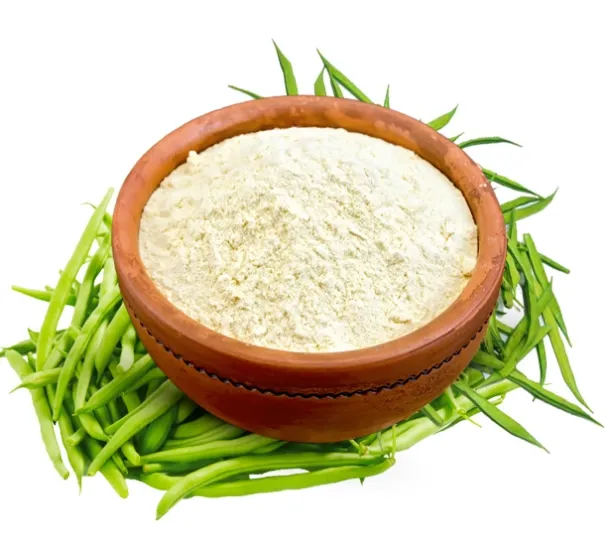
Food & Beverage Ingredients
Guar Gum Powder
Food-Grade Guar Gum Powder is a plant-derived hydrocolloid used as a thickener, stabilizer, and texture modifier in food and beverage formulations. It is commonly used in dairy products, frozen desserts, sauces, bakery applications, and dry mixes. ANADYO is a China-based B2B ingredient supplier supporting international food manufacturers, ingredient importers, and distributors with guar gum sourcing, quality documentation, and bulk purchasing.
Product Overview
Food-Grade Guar Gum Powder (CAS 9000-30-0), also known as Guar Gum, Guar Flour, or E412 / INS 412, is a plant-derived hydrocolloid obtained from the seeds of the guar plant (Cyamopsis tetragonoloba).
It is used in food manufacturing primarily for thickening, stabilization, water binding, and texture control. Guar gum hydrates in cold water and can develop substantial viscosity at relatively low concentrations.
ANADYO supports international B2B buyers sourcing food-grade guar gum for commercial food and beverage production, with viscosity-grade selection, quality documentation, sample orders, and bulk purchasing arrangements.
Commercial Specifications & Supply
Food-grade guar gum is commonly traded by viscosity grade and particle size, rather than a single percentage assay.
Commercial viscosity grades commonly include approximately 3,500–6,000 cP, measured using a 1% aqueous dispersion at 25°C under defined testing conditions.
Item | Details |
|---|---|
Product | Food-Grade Guar Gum Powder |
Appearance | White to Yellowish-White Powder |
Common Viscosity Grades | 3,500–6,000 cP |
Viscosity Reference | 1% Aqueous Dispersion at 25°C |
Common Particle Sizes | 100–200 Mesh |
Standard MOQ | 25 kg |
Sample Orders | From 1 kg |
Standard Packaging | 25 kg/drum |
Documentation | COA with Specifications |
The viscosity and mesh values above are common commercial references. Specific grade availability, testing conditions, and physical properties are confirmed according to the selected supply option.
Viscosity Grades & Hydration Performance
Choosing the Appropriate Viscosity Grade
Viscosity is one of the primary purchasing criteria for food-grade guar gum.
Different viscosity grades may be selected depending on the required thickness, mouthfeel, water retention, and processing characteristics of the finished food product.
Higher-viscosity grades can produce greater thickening under comparable testing conditions, but they are not automatically better for every formulation.
Buyers should select the grade according to the intended application, processing equipment, and target finished-product texture.
Why Testing Conditions Matter
Guar gum viscosity depends on several factors, including concentration, temperature, hydration time, mixing conditions, and measurement method.
When comparing supplier quotations or COA results, buyers should confirm that viscosity values are measured under comparable conditions.
For example, two grades described as 5,000 cP may not perform identically if their hydration times, testing methods, or particle characteristics differ.
Particle Size & Dispersion
Guar gum powder is available in different particle-size specifications, commonly expressed in mesh.
Finer particle sizes may affect hydration speed and dispersion behavior. However, poorly controlled powder addition can lead to lump formation during mixing.
Food manufacturers should evaluate dispersion procedures, mixing intensity, and hydration conditions when selecting a guar gum grade.
Food & Beverage Applications
Ice Cream, Frozen Desserts & Dairy Products
Guar gum is commonly used as a stabilizer and thickener in ice cream, frozen desserts, and selected dairy formulations.
Its water-binding and viscosity-building properties can help control texture and reduce undesirable changes associated with ice crystal development.
Formulators should evaluate the guar gum concentration, stabilizer system, and processing conditions to achieve the required texture and storage performance.
Sauces, Dressings & Processed Foods
In sauces, dressings, gravies, and other processed foods, guar gum is used to increase viscosity and improve texture consistency.
Its shear-thinning behavior can be useful in products that require thickness at rest while remaining easier to pour or mix under shear.
Manufacturers should evaluate the formulation's pH, salt content, processing temperature, and interactions with other ingredients.
Bakery & Gluten-Free Formulations
Guar gum is used in selected bakery and gluten-free products to support water management and texture development.
Its suitability depends on the flour system, ingredient combination, and manufacturing process.
For gluten-free formulations, buyers should evaluate hydration characteristics and interactions with starches, proteins, and other hydrocolloids rather than assuming that guar gum can directly replace gluten functionality.
Beverage Mixes & Dry Food Blends
Food-grade guar gum may be incorporated into powdered drink mixes, dessert preparations, and other dry food formulations requiring thickening or texture modification after hydration.
For dry blends, particle-size compatibility, ingredient distribution, dispersibility, and the desired viscosity development time are relevant formulation considerations.
Quality Documentation & Supplier Qualification
Food-Grade Quality Evaluation
For international food ingredient procurement, buyers should verify that the selected guar gum grade meets the requirements of its intended application and destination market.
Important quality parameters may include:
- Viscosity: Declared viscosity range and corresponding testing conditions.
- Particle Size: Mesh specification and particle-size distribution.
- Moisture: Applicable moisture or loss-on-drying limits.
- Galactomannan Content: Relevant compositional requirements for the selected food-grade standard.
- Microbiological Quality: Applicable limits for microbial counts and specified pathogens.
- Contaminants & Impurities: Relevant heavy metals, residual processing substances, and other market-specific limits.
The corresponding COA with Specifications should be reviewed against the buyer's purchasing and quality requirements.
Food Additive Standards & Regulatory Requirements
Guar Gum is identified internationally as INS 412 and in the European Union as E412.
For the United States, Guar Gum is addressed under 21 CFR 184.1339. In the European Union, its permitted uses and applicable specifications are governed by the relevant food additive regulations.
These regulatory references establish ingredient identity and applicable frameworks; they do not independently establish that every commercial guar gum grade meets the requirements of a particular destination market.
Buyers should verify the relevant purity criteria, permitted food categories, use levels, and labeling requirements before commercialization.
Certification & Manufacturing Documentation
International food manufacturers may require additional certification or manufacturing-site qualification documents during supplier approval.
If your purchasing process requires Halal, Kosher, FSSC 22000, ISO 22000, HACCP, or other relevant documentation, please specify the requirement when requesting a quotation.
ANADYO can check document availability and applicability for the selected guar gum grade and supply source. Any certification or manufacturing-site qualification must be verified for its scope, validity, and relevant issuing body.
FAQ
What viscosity grade should I choose for food manufacturing?
The appropriate viscosity depends on the finished-product texture, ingredient concentration, and processing conditions. Buyers should specify the target viscosity and intended application so that suitable commercial grades can be evaluated.
Is food-grade guar gum the same as industrial-grade guar gum?
Both may originate from guar seeds, but they are not interchangeable for food manufacturing. Food-grade material must meet the applicable identity, purity, safety, and regulatory requirements for its intended use.
Industrial-grade specifications should not be accepted as evidence of food-grade compliance.
Can Guar Gum replace Xanthan Gum?
Not necessarily. Both are food hydrocolloids, but their hydration behavior, viscosity profiles, and interactions with other ingredients differ.
Any substitution should be evaluated through formulation trials rather than replacing one ingredient with the other at an identical inclusion level.
Can I request Halal, Kosher, or food safety system documentation?
Yes. Please identify the required certification or manufacturing-site standard when submitting your inquiry. Document availability and applicability will be checked for the selected grade and supply source.
Request a Quote
Looking for a Food-Grade Guar Gum Powder supplier in China?
Contact sales@anadyobio.com with your required viscosity grade, mesh size, estimated quantity, destination country, and any certification requirements to request a COA with Specifications and quotation.